How to
What should my tyre pressure be? How to find and check it
Where to find the right tyre pressure for your car, psi or bar, loaded figures, how often to check, the warning light, the MOT and the law.
Your tyre pressure should be the figure your car's manufacturer gives for your car, not the number moulded on the tyre. You will find it on a label in the driver's door frame or inside the fuel filler flap, and in the handbook, often with a second, higher figure for a full load. Check it when the tyres are cold: the Highway Code says weekly, and TyreSafe says at least once a month and before long journeys.
Where to find the tyre pressure for your car
Look in three places:
- The door frame. Open the driver's door and look for a label on the edge of the door or on the pillar it closes onto. In some cars it is on the passenger side.
- The fuel filler flap. Many cars have the label inside the flap.
- The handbook. The tyre section lists the pressures for each tyre size fitted to your model.
Michelin points out that the recommended pressure for the front and rear tyres may not be the same, so read both columns. If the label lists several tyre sizes, use the line that matches the size on your tyre sidewall. No label and no handbook? A tyre fitter or your dealer can look the figure up.
psi, bar and kPa
Labels and handbooks give the pressure in psi, bar or kPa. One bar is 100 kPa, or about 14.5 psi. This table converts common figures; it is not a list of recommended pressures.
| bar | psi (approx.) | kPa |
|---|---|---|
| 2.0 | 29 | 200 |
| 2.2 | 32 | 220 |
| 2.4 | 35 | 240 |
| 2.5 | 36 | 250 |
| 2.7 | 39 | 270 |
| 3.0 | 44 | 300 |
Set your gauge or inflator to the same unit as your label, and you will not need to convert at all.
Normal and fully loaded pressures
The Highway Code says tyres MUST be correctly inflated to the vehicle manufacturer's specification for the load being carried. That is why many labels show two sets of figures: a normal pressure and a loaded pressure. Michelin describes the loaded figure as the one to use when the car is particularly loaded, for example when you go on holiday. TyreSafe also advises raising pressures in line with the manufacturer's figures when you tow a caravan or trailer. Go back to the normal figure once the car is empty again.
Why not use the maximum on the sidewall?
Every tyre has a maximum pressure moulded on its sidewall. Pirelli explains that this figure comes from the tyre maker and is the most the tyre can withstand. It is not the pressure your car needs. Running at the maximum every day makes handling and braking worse, raises the risk of a blowout and wears the centre of the tread early.
Check when the tyres are cold
Label pressures are cold pressures. The Highway Code says to check before your journey, when tyres are cold, because warm or hot tyres may give a misleading reading. Pirelli adds that heat from driving or strong sun can raise the pressure by several psi. TyreSafe suggests checking before the car has been driven two miles.
If you check straight after a drive, the reading will be higher than the label figure. Do not let air out to match it; wait until the tyres have cooled and check again.
When should tyre pressure be checked?
- Weekly, as the Highway Code advises, or at least once a month as TyreSafe recommends.
- Before a long journey, and before you load the car for a holiday or hitch up a trailer.
- Whenever the warning light comes on.
Tyres lose some air even when nothing is wrong. Michelin puts it at around 0.07 bar a month, and says not to wait for the warning light before you check. TyreSafe makes the same point: the monitoring system is a warning, not a reminder, so check with an accurate gauge even if your car has one.
How to check and inflate your tyres
- Look up your figure, normal or loaded, front and rear.
- Park on level ground, switch off the engine and apply the handbrake.
- Unscrew the valve cap and keep it somewhere safe.
- Press the gauge or the inflator's connector firmly onto the valve and read the pressure.
- If it is low, add air and read again. If it is too high, press the pin in the centre of the valve briefly to let a little out, then read again.
- Refit the valve cap and repeat on every tyre, including the spare if your car has one.
- While you are down there, look for cuts, bulges and anything stuck in the tread.
- If one tyre keeps losing pressure, have it checked by a tyre fitter.
- If your car has a monitoring system that needs resetting after you inflate the tyres, follow the handbook.
The tyre pressure warning light
The warning light is part of the tyre pressure monitoring system (TPMS), which Goodyear says has been mandatory on all new cars in the UK since 2014. Toyota describes the lamp as a yellow symbol that looks like the cross-section of a tyre with an exclamation mark inside. It means at least one tyre has dropped below the system's limit, which can point to a puncture or slow leak.
There are two kinds of system. A direct system has a sensor at the valve in each wheel. An indirect system works out pressure loss from the ABS wheel speed sensors. According to Goodyear, a direct system does not need resetting after you inflate the tyres, but an indirect one does.
When the light comes on, stop as soon as it is safe and check all four tyres with a gauge. If a tyre is low but undamaged, inflate it to the correct figure. If it is flat or damaged, use the spare or a repair kit, or call your breakdown service. If the light flashes for a while and then stays on, the system itself may have a fault, which is a job for a garage.
Tyre pressure, the MOT and the law
- Inflation is a legal requirement. The Road Vehicles (Construction and Use) Regulations 1986 say you must not use a car on a road if a tyre is not inflated enough to make it fit for its use.
- Tread depth. The Highway Code says cars, light vans and light trailers MUST have at least 1.6 mm of tread across the central three-quarters of the tread.
- Penalties. Using a vehicle with defective tyres carries 3 penalty points (code CU30 on GOV.UK). The Sentencing Council's guideline gives a maximum fine of £2,500 for a car, and the fine is for each defective tyre. Ordinarily only one set of points applies when several offences are committed on the same occasion.
- The MOT. For cars first used on or after 1 January 2012, the MOT inspection manual lists a TPMS that is malfunctioning or obviously not working as a major defect, which fails the test. An obviously under-inflated tyre is a minor defect. Tread below the legal limit is a dangerous defect.
Why the right pressure matters
Pirelli explains that an under-inflated tyre runs hot, which can make the tread separate and lead to a blowout at motorway speeds. Low pressure also increases rolling resistance, so the car uses more fuel, and the tyre wears faster and unevenly. Too much pressure is no better: handling and braking suffer, and the centre of the tread wears early.
Checking at home with a cordless inflator
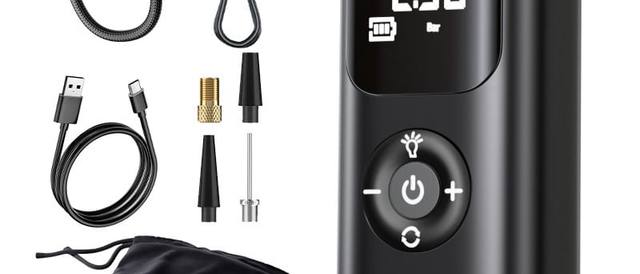
Our cordless tyre inflator with digital gauge shows the tyre pressure on a display as soon as you connect it. You set the pressure your car needs with the plus and minus buttons and press start; according to the supplier, the pump then does the rest. The mode button changes the pressure unit, and a built-in light helps on dark evenings.
It runs on its rechargeable battery, which charges by USB-C, or from the car's 12V socket with the cable in the box. A Presta adapter, a ball needle and two cone nozzles come in the storage pouch for bikes, balls and inflatables.
Be realistic about what it is. The supplier does not state the battery capacity, so we cannot say how many tyres it fills per charge. Topping up is quick, but filling a completely flat tyre takes much longer. See all our tyre inflators, and if you are buying for someone else, our car gifts guide has more ideas.
Frequently asked questions
What should my tyre pressure be?
Use the figure your car's manufacturer gives for your car and tyre size. It is on a label, usually in the driver's door frame or inside the fuel filler flap, and in the handbook. Front and rear can differ. Use the loaded figure when the car is full, and never inflate to the maximum pressure printed on the tyre sidewall.
When should tyre pressure be checked?
The Highway Code says to check tyre pressures weekly, before a journey, when the tyres are cold. TyreSafe recommends at least once a month and before any long journey. A cold check matters because warm tyres read higher than the figure on the label.
What does the tyre pressure warning light mean?
It is the warning lamp of the tyre pressure monitoring system (TPMS), a yellow tyre outline with an exclamation mark. It means at least one tyre has lost pressure, perhaps from a puncture or slow leak. Stop when it is safe, check all four tyres with a gauge and inflate them to the correct figure. If the lamp flashes and then stays on, the system itself may have a fault.
Will the tyre pressure warning light fail the MOT?
On cars first used on or after 1 January 2012, the MOT checks the TPMS warning lamp. A system that is malfunctioning or obviously not working is a major defect, which means a fail. An obviously under-inflated tyre on such a car is a minor defect, which does not fail the test on its own.
How do I convert bar to psi?
1 bar is 100 kPa, or about 14.5 psi. So 2.2 bar is about 32 psi and 2.5 bar is about 36 psi. Set your gauge to the unit on your label; on our cordless inflator, the mode button changes the pressure unit.